
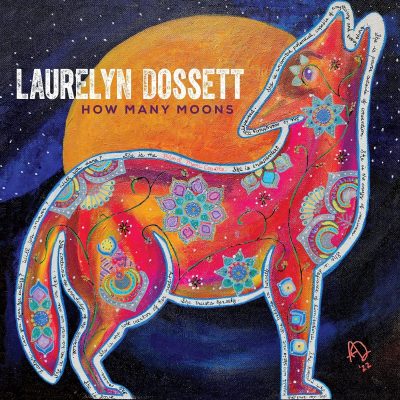
How many moments make up a life? Laurelyn Dossett has spent over thirty years writing songs for others, songs performed by the likes of Levon Helm and the Carolina Chocolate Drops. She’s written music for plays, toured with the North Carolina Symphony and she’s a regular at Merlefest. Not bad for a woman who has never recorded an album. There has been little fanfare for How Many Moons, her solo debut even though nothing quite compares to it. It is a surprisingly reassured record, lived in and alive with confidence. Just waiting for the right moment to arrive on the scene.
The confidence Dossett has gained crafting songs for others these last thirty years comes to fruition from the opening notes of ‘The Vision and The Call’. Starting with the count off to the violin and guitars brimming with life, this is a journey through the North Carolina countryside, assisted by the steady hand of Hiss Golden Messenger’s M. C. Taylor. Understanding the landscape of the soul Dossett sings, “The priests and money changers pay but pennies for her wing/ But the snow white-throated sparrow/ Throws her head back and she sings.”
Surprises abound at every turn. Where Levon Helm’s version of ‘Anna Lee’ was a gospel gem, Dossett’s version comes from a place, smoother, more mannered despite the sounds of banjo and organ. Combined with harmony vocals from two-time Grammy winner Rhiannon Giddens, this song seems torn from the pages of time despite it’s modern origin. Which is a testimony to Dossett’s craft.
The sound of stately guitar, later replaced by piano, leads the tender tale of ‘War, West Virgina’. Less a place than a state of mind, the analogy is one where Dossett finds her lover unwilling to fight for her, even as she shows her own willingness to lay her body down for him. The lyric makes it clear, “Some things are worth dying for/ We should have gone to war/ It appears I am the casualty/ We should have gone to war.”
Trust makes affairs of the heart so much more painful, or should I say the lack of trust. ‘Believe Me’ faces that head on. The piano keeps the beat, along with the strum of guitar, as Dossett lays it out clearly. “Before ashes to ashes/ Turn dust into dust/ Before our time passes/ Turn these tears into trust.” Yet trust is hard to come by, as becomes obvious, “No promise, no kiss/ Can prove that I love you/ ‘Cause you don’t believe me.” Nothing more needs to be said.
As a songwriter Dossett refuses the constraints of any particular style. She uses what works while abandoning those structures that would constrain her. ‘Glory Glory’ reveals the depths of her songwriting, whether it’s from North Carolina backyards to churchyards. There’s a depth to the song that shows religious roots while still transcending them. “Come lost and weary/ Come wanderin’ friend/ Come to the glory, to the wilderland.” Closing with a arrangement straight out of the choir, it’s a perfect conclusion to a collection that goes far beyond any particular genre.
True to her roots, Laurelyn Dossett has created a work worthy of skill as a songwriter. At last, on How Many Moons she stands exactly where she belongs, front and centre, in the spotlight.