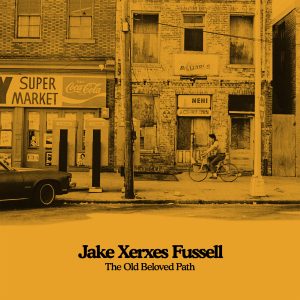
A self-professed “folk music dork” in high school, Jake Xerxes Fussell doesn’t find satisfaction in creating songs. Instead, he digs through the dark corners, rediscovering of folk songs, mining regional variations, trying to realign and recontextualise tunes for the twenty-first century. On his sixth album, The Old Beloved Path, what emerges is a man who finds ways to illustrate how folk has never been a static musical form. Each musician and each generation reinvigorates the form, yet few do it with the creative contextualisation of Fussell.
From the opening notes of ‘No. 1’ his guitar playing, slowly but surely, offers a wide-screen view of a man at ease with his place in the world. The notes of his guitar fuel a vision of a man who is comfortable in his own skin. Fussell doesn’t try to show how many notes he can play. They emerge at their own pace, much like the Georgia of his birth, and the North Carolina where he now resides. Each note, each phrase, re-examines what this music is in the twenty-first century.
Taking on ‘Rock Island Line’ he adds a relaxed feel, merging his guitar with a lyrical blend incorporating an old English nursery rhyme. The original song felt too common place on its own. Too many folk singers had done the tune before, but combining “Wire, briar, limberlock/ How many geese is in our flock” with “If you want to ride, you got to ride it like you’re flyin’/ Get your ticket at the station on the Rock Island Line” spoke to him. In that instant he knew he could make it all his own.
What intrigues about Fussell’s music is the way he reinvents musical contexts for traditional lyrics. ‘Every Time I Go to Town’ lays out theme for more than a minute before he begins to sing. “Every time I go to town/ The boys start kicking my dog around/ I don’t care she’s just a hound/ Better stop kicking my dog around” are the only words he sings, yet within the bed of guitar and harmonica a vision emerges where you can almost feel the dusty old roads of that town.
Doing so much with so few instruments and notes becomes an integral part of the equation. ‘Boney’ recounts the some of the moments of Napoleon Bonaparte. Based on a ‘short drag’ sea chantey which was used to accompany and keep pace for a brief shipboard hauling task, the song was also heard long after the days of sailing had long passed. Through many versions the song told of Bonaparte’s dancing and cursing in some versions, while others had him crossing the Rocky Mountains as well as the Alps. Such is the tale of how tunes change over time depending on locale and mindset.
‘Boll Weevil’ offers an ever-changing view of the parasite. From a quirky nuisance to a shrewd and savvy market competitor, Fussell acknowledges that it all depends on time and place. As he relates, “Often the Boll Weevil is all these things in one song. Like so many of us, he’s looking for a home.” The parasite also takes on human qualities in this version, “The first time I saw the boll weevil/ He was sittin’ on the square/ And next time I seen him/ He had his whole family there.” Context is everything.
Times change and tunes change. In the hands of such a dedicate singer and guitarist as Jake Xerxes Fussell, The Old Beloved Path doesn’t just honour the journey of songs, but the journey of man. This journey continues in the hands of a craftsman who knows the road goes ever onward.