
 “I’m traveling in some vehicle/ I’m sitting in some cafe/ A defector from the petty wars/ Until love sucks me back that way”
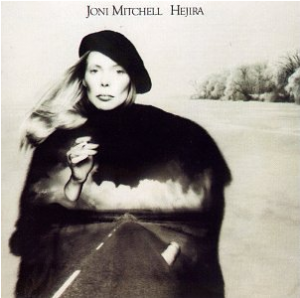
Hejira represented a new peak of sophistication in Joni Mitchell’s writing when it appeared on Asylum Records in November 1976. Reactions to her third-person narratives on 1975’s The Hissing of Summer Lawns were mixed to say the least, but rather than a retread of old ground and old themes, Hejira finds Mitchell’s self-analysis frequently attaining the level of elevated poetry. Musically, too, its moody, bass-accented arrangements and jazz-inspired chord progressions cemented her status as one of her generation’s key visionaries and fearless experimentalists.
After her tour to support The Hissing of Summer Lawns wrapped up in February 1976, Mitchell’s tempestuous relationship with drummer John Guerin came to an end. Seeking solace in the company of friends, she travelled across to Maine from California to drop a couple of friends off at one of their daughters’ houses. Travelling back down through Florida, around the Gulf of Mexico, and back to California through the Southwest, the songs that comprise Hejira began to take shape.
Mitchell had already written and played a couple of the songs on tour – “Coyote,” allegedly inspired by Sam Shepard, was written in late 1975 and thrills with Jaco Pastorius’ insistent bass lines and Mitchell’s frenetic, verbose delivery; and “Furry Sings the Blues,” written after her encounter with old bluesman Furry Lewis on tour in Memphis in January 1976, is wonderfully evocative, with Neil Young’s harmonica adding to the rustic charm – but all those other gems came together out of Mitchell’s solitary travels back through the States.
Thus, “Amelia,” arguably Hejira‘s most enduringly beautiful six minutes, finds Mitchell, in the wake of her relationship’s demise, drawing parallels between herself and the ill-fated pilot Amelia Earhart as she drives through the Arizona desert – “one solo pilot speaking to another,” as she recalled in 2006. Lines like “Maybe I’ve never really loved / I guess that is the truth / I’ve spent my whole life in clouds at icy altitudes / And looking down on everything / I crashed into his arms / Amelia, it was just a false alarm” don’t skimp on honesty; but where Mitchell was once disarmingly frank (“I’m so hard to handle / I’m selfish and I’m sad” on “River”), here she is reflective, resigned, and has mastered the art of incorporating metaphor into the song lyric. Dylan is renowned as the premiere lyricist of his generation, but Mitchell’s lyrics stand alone on the page just as readily.
Elsewhere, there are snapshots of Mitchell’s more memorable experiences on the road (“A Strange Boy” details her affair with one of the men with whom she initially drove to Maine in the spring of 1976) and lamentations of travel-weariness (the chugging “Black Crow”), as well as a torch song oddity in “Blue Motel Room,” in which she imagines somewhat facetiously that she and Guerin can make a go of things again, using the Cold War metaphor to emphasise their sense of competition and creative rivalry.
But it’s on the broader songs of deep philosophising that Mitchell shines. “Song for Sharon” is an eight-minute epic that begins in New York City but winds up just about everywhere, as Mitchell pens an open letter to her childhood friend back in Canada. Mitchell muses on topics ranging from motherhood to ecology to the nature of her career; slotting in a humorous line like “there’s a gypsy down on Bleecker Street / I went in to see her as a kind of joke / and she lit a candle for my love-luck / and eighteen bucks went up in smoke!” rests comfortable alongside lines and images of a much more serious, contemplative nature – a testament to Mitchell’s confidence and assurance in her writing style and ability at this point in her career. (It’s also interesting to note that “Sharon” was written while Mitchell was high on cocaine – you know those pithy background vocals had to come from somewhere.)
Meanwhile, “Hejira” and “Refuge of the Roads” pretty much sum up the ethos of the entire record. There’s a deep sense of loneliness in both, but where “Hejira,” with its atmospheric guitar lines and churning rhythms, remains tight in its bleak, grey mood, there’s an optimism in “Refuge of the Roads” that suggests the protagonist has achieved some sense of self-discovery. You get the feeling in “Hejira” that she is looking for something, confused and self-critical (“I’m porous with travel fever / But you know I’m so glad to be on my own / Still somehow the slightest touch of a stranger / Can set up trembling in my bones”), while in “Refuge of the Roads,” realising her place in the world, she’s arrived at some kind of peace. The final verse on the album is one of its most memorable, putting Mitchell’s self-analysis and solitary travel into marvellous perspective with a stream of beautiful images:
“In a highway service station/ Over the month of June/ Was a photograph of the earth/ Taken coming back from the moon/ And you couldn’t see a city/ On that marbled bowling ball/ Or a forest or a highway/ Or me here least of all/ You couldn’t see these cold water restrooms/ Or this baggage overload/ Westbound and rolling taking refuge in the roads”
Deciding what is the “best” Joni Mitchell album is pretty academic; each record from 1971’s Blue up to Hejira is really a five-star masterpiece, and there’s a strong case for including the ambitious, experimental Don Juan’s Reckless Daughter in that list too. For the Roses finds Mitchell in top vocal form, experimenting with song structures; Court and Spark achieves a new level of melodic complexity and finds Mitchell exploring alternate vocal styles; and The Hissing of Summer Lawns is a sleek, sublime piece of work, lyrically again a new peak and musically admirable in its scope and ambition. But Hejira possesses an inner confidence and cohesion that marks it out. Gone are the vocal acrobatics and dazzling studio experiments of the previous two records. In their stead is a work where the focus is on Mitchell’s lyrics, her story, her travelogue. Backed by a tight band that craft the perfect moody atmosphere around Mitchell’s structures, she mixes self-analysis with observation with customary inimitable aplomb. It’s not her most accessible or most immediately attractive work, but from hearing the record to reading the lyric sheet to looking at that iconic cover, Hejira is a byword for pop music sophistication and an experience to treasure.
Perhaps Joni Mitchell herself said it best, when talking about the album in 2006: “I suppose a lot of people could have written a lot of my other songs, but I feel the songs on Hejira could only have come from me.”
Words: Matthew Barton