
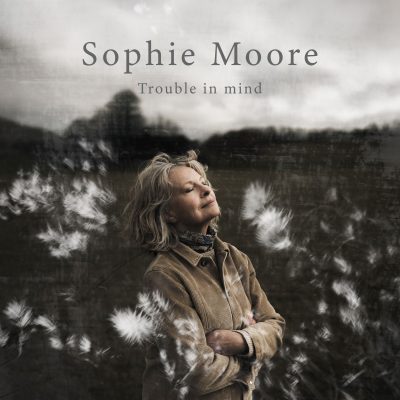
Sophie Moore knows only too well songs don’t always provide answers. And singing hasn’t always been the answer for her. From singing with her brother Julian in Foggy Cry and sharing the stage with Hawkwind in the 80s, to working with Jeb Loy Nichols during a stretch in the 90s, music was in her blood. Yet during more than 20 years as a therapist in physical and mental health services it became obvious some questions have more than one solution. What works for one may not work for another, so answers can be hard to come by. Though never far from music, Trouble in Mind, her first release in far too long, doesn’t waste time on the unanswerable, settling for simple truths that help to make it through the day.
In a matter of three days, recording at producer Mark Nevers studio in South Carolina on Pawley’s Island, a handpicked selection of musicians, from guitarists Williams Tyler and Paul Niehaus, drummer Joe Westerlund, along with Tony Crow on piano and Roy Agee on horns, laid down the tracks that would become Trouble in Mind. As brief as those sessions were, the music and Moore’s voice are undeniable. As Nevers explains, “…once Sophie started singing in the studio it was obvious she was gifted with a sublime vice and a natural instinct of how to use it.”
Sometimes brass music hits you in the face and while the opening to ‘Closer Than’ doesn’t exactly creep up on you, it holds off until just after the drums enter, before filling the frame. Agee (who played with Prince) never overpowers Moore, finding phrase after phrase to punctuate the proceedings without ever over playing his hand. Combining with Crow’s piano, they form a potent duo to expand the palette created by Moore as she sings, “Don’t stop taking chances/ Don’t be afraid of the cost/ Live the stuff of dreams before the time is lost.” As the song fades out one wishes it could go on forever.
Maturity is a gift, even if it’s not generally recognized as one. Moore views an old relationship from a new perspective on ‘Maybe I’ll Be Here Again’. The piano wistfully pictures the scene, looking at the setting as she wonders, “Maybe I’ll be here again/ So should I call on you like a friend/ If I’m traveling through?” The music rises and falls, yet along the way, the question never gets answered. Is there one that even makes sense?
Nevers production brings out the best in Moore, from the gentle breezes of ‘All the Small Secrets’ to the chorus of voices on ‘Trouble in Mind’. Opening gently with piano playing against the simplest of drums, the song builds with Moore’s voice becoming stronger, then falling back to a softer tone at the songs end. Just as he did with Lambchop on Nixon and Is A Woman, Nevers understands how to make a song come alive.
For someone who has spent too much time on the sidelines, Sophie Moore’s Trouble in Mind is an admirable way to rejoin the fray. Her wealth of experiences, both inside the music industry and outside of it, have given her the insight and inspiration to create a most memorable work of art.