
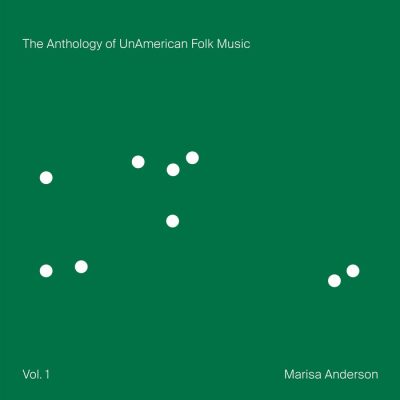
More than merely a name, Marisa Anderson’s The Anthology of UnAmerican Folk Music Vol. 1, is an attempt to transform the musical and political landscape. Granted access to recordings from the private record collection of renowned musicologist Harry Smith, Anderson focused on recordings from countries the United States has been in conflict with since 1970. She has created an audio dialogue with music from what was the USSR, Southeast Asia, Arabic and Islamic regions, framing a question, “Who are the people we’ve been told in our lifetimes are ‘unamerican?’ What have we all lost or been denied access to in the fallout from that label?”
Opening the album with ‘Hamd’, an Arabic piece expressing praise and gratitude dedicated to Allah, Anderson uses an acoustic guitar to fingerpick devotion. Central to many Islamic cultures, a ‘Hamd’ generally is the first song played. It offers a gentle way in, being one of the most western sounding songs on the record. This devotion, wonderfully settling, illustrates that regardless of culture, a higher power can provide the centering needed to achieve transcendence.
‘Pair of Duduk’ begins to show the eastern influence on a larger scale as Anderson’s guitar is played in combination with the duduk, which is played in countries from the Middle East to Balkans and the Caucasus. Combining the droning tones of the instrument with the guitar, offers a slow pulse for the guitar to play against. Together they combine to form a blend that transcends regional norms. Slightly sad, the guitar frames the tones and textures of the duduk that rather than crossing cultures provides a way to transcend differences.
Although known as a remarkable improvisor, Anderson’s work on The Anthology of UnAmerican Folk Music Vol. 1 is highly researched. ‘Sarvi Simin’ is song originally found on Musical Instruments of the People of the USSR released in 1977. She transcribed the song while traveling around Mexico by bus during the winter of 2025. Originally she had the idea to record it in combination with an accordion, however, the song took on a life of its own when recorded as a duet with Gisela Rodríguez Fernández on violin. Blending beautifully on the song, it proves that regardless of cultural origin, the right musicians can perform magic.
Based on ‘Taqsim for Violin’, Anderson’s ‘Taqsim for Guitar’ strays from the idea of a taqsim. She notes, “A taqsim is an improvised piece of music preceding a more formal piece. My arrangement is not a true taqsim as it closely follows the recorded piece and thus is not improvised.” The song deftly recasts this Syrian improvisation creating a song that was never written down.
With two other discs of music intended to follow The Anthology Of UnAmerican Folk Music Vol. 1, Marissa Anderson has created a cross-cultural landmark to countries who often are overlooked in the western world. But music crosses borders and thanks to artists like Anderson those notes can provide a framework to compromise throughout the world.