
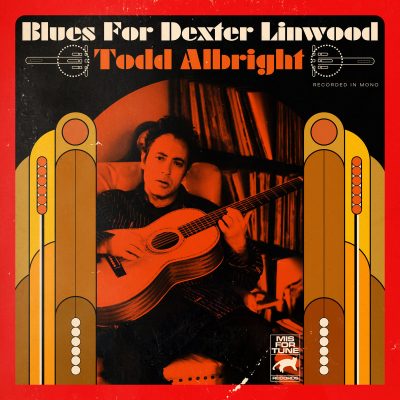
It’s going to take longer to write this review than it took Todd Albright to record and mix Blues for Dexter Linwood. Having played the songs live for a number of years, he went into a studio and laid down all the songs live in an hour and a half, never doing more than one or two takes, using a single microphone, emulating the technique that an artist like Blind Lemon Jefferson used back in 1926. After all, you never get second chances on stage.
Using a 12-string guitar, he bends it to his will on a collection of songs from days gone by. Part of what makes Blind Willie McTell’s ‘Drive Away Blues’ so interesting are lyrics that never make logical sense yet are incredibly visual. McTell was big on place names. As Albright relates, “… he was going to ‘go up to Lookout Mountain’ and ‘look down on Niagara Falls’. How the hell are you going to do that? Lookout Mountain is in Georgia! But, he was blind, so maybe he was seeing things that we couldn’t. Little things like that make me giggle.” What makes you gasp, however, is the way Albright’s fingers dance over the strings. His finger-picking technique displays a level of complexity unseen during the 1920s.
Blind Lemon Jefferson’s ‘Stockin’ Feet Blues’ boogies in the old style, featuring a ragtime swing and Albright imbues it with an almost rap delivery (at least it would be rap in the modern world). Employing a slide on Peg Leg Howell’s ‘Skin Game Blues,’ the tale of an itinerate gambler comes to life. The slide comes into play again on ‘Step It Up And Go’, where against opening blues harp strains a tale of loving, infidelity, leaving and finding new love plays out briskly.
The rhythmic tremolo and syncopation of ‘Shuckin’ Sugar Blues’ highlights Albright’s take on the glories marriage and fidelity. Yet, in the end, it’s all just too much, “I’m tired of this marryin’, tired of this settlin’ down, shuckin’ sugar/ I believe wanna stay like I am and slip from town to town.” The one song from more modern times is Paul Geremia’s ‘If That Woman’s Love Was Whiskey’, although Albright notes, “The original tongue-in-cheek title for that song was, ‘If That Woman’s Love Was Whiskey, That’d Be All The Proof I Need’. But it was a little long to be put on a record.” Instead of playing exactly like Geremia, the song is a ‘misremembrance,’ where he tries to guess without listening to the song how it sounds, then goes back to the original and see how close he came.
The final song on Blues for Dexter Linwood is ‘The Fort Worth and Dallas Blues’. According to Albright, “Huddie Ledbetter, better known as Lead Belly, said this is a tune that he and Blind Lemon Jefferson played on the streets of Dallas and Fort Worth, Texas, in the 19-teens. Apparently, the song went over big, and they were showered with money every time they played it. So far, I have not had that experience.” That hasn’t stopped Todd Albright from displaying a fidelity to songs that may be out of fashion, but in his hands these tunes will never go out of style.