
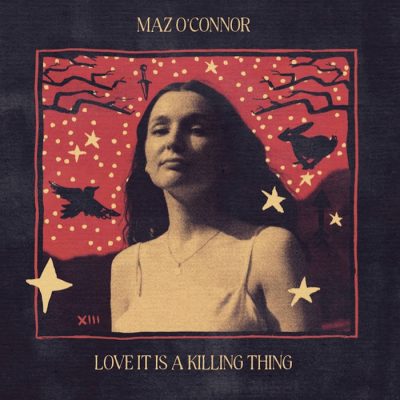
One of the enduring qualities of folk music is that its roots grow deep and once ensnared in those roots they don’t let go. Maz O’Connor has always been under the sway of traditional music. Her fifth album coming after the birth of her first child, and working on the musical, The Wife of Michael Cleary, she found herself drawn to the songs she grew up with. “Having a child connected me with deepest, oldest self, and for me that’s traditional folk song. Where my musical journey began.” Love It Is a Killing Thing goes back to that template recontextualizing the tradition for a new generation.
Having been sung again and again over the ages, the songs like pebbles in the ocean have been worn smooth, leaving the best music and lyrics at their core. For her fellow travellers on this journey through the past and into the future ,she chose Zack Hobbs, the grandson of Richard and Linda Thompson, and Anna Rheingans. Recording live to tape without overdubs, the results have an undeniable purity. O’Connor imbues them with a sense of timelessness; these are songs rooted in the dark mysteries of human nature.
Taking liberties with ‘Once I Had a Sweetheart’, O’Connor created a new melody for the song. Using guitar, banjo, bass and drums, the song has an ageless feel. There’s a dark sadness to her vocal as she sings, “Once I had a sweetheart/ Now I have none.” At points the song feels like it could have come from the depths of the Fairport Convention catalogue.
Building off the base of ‘Hares on the Mountain’ O’Connor was inspired by the teenagers who were learning the song to rewrite the genders in the song to make more sense. Suddenly the song made more sense as a testament to male violence toward women, especially with the addition of a new final verse.
There are countless versions of ‘Silver Dagger’. At its most basic, the song is about a woman swearing off men because of a fear of heartbreak, or the actual experience of it. Regardless of the case, O’Connor offers a vocal tinged with a sense of sadness even as the combination of guitar and banjo breezes along, although filled with just a touch of remorse.
Throughout this collection of songs, O’Connor changes melodies or lyrics to fit with today’s times and tides. She understands that at their root these songs have been modified to meet the changing needs of a new generation. Folk music is not some untouchable collection of notes and meters. ‘Jenny Put the Kettle On’ initially has traditional lyrics, but along the way she rewrites the song while still maintaining it basis in a song about a woman not allowed to marry the man she loves.
The album’s final song, ‘Come and I Will Sing You’, incorporates a mixture of Christianity and Paganism inherent in British folk songs. Give the song a repetitive, mesmeric feel, O’Connor offers the feel of gatherings for the solstice, where chanting and dancing would go on in an ecstatic celebration of the changing seasons.
Reinvigorating folk for the 21st century, Maz O’Connor’s Love Is a Killing Thing builds on traditional frameworks while finding ways to recontextualize the music for a new generation.