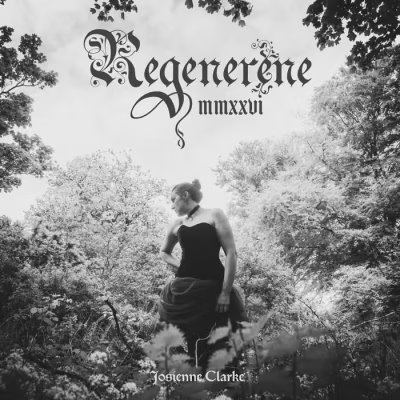
In life, lots of people would say that it’s always important to look forward, but I would say it’s vital to sometimes take stock of where you’ve come from and tip a hat in the direction of the things that have made you the person you are today. That’s what Josienne Clarke has decided to do on her latest album, a sparse and beautiful love letter to the songs that shaped her sound.
There are callbacks and echoes to her past self littered through Regenerene MMXXVI, some songs were even released on The Seas are Deep some 15 years ago, which marked the first substantial step on the path Clarke has been travelling on ever since. That path has never been straight and true, with various obstacles and tangents thrown in but, in reaching the second half of her second decade as a recording artist, Clarke has decided to celebrate in the manner that she has made her own. The album opens with ‘Katie Cruel’ and ‘Banks of the Sweet Primroses’, an iconic one-two from the folk cannon, laying the foundations for what is to follow.
“Human emotion remains a constant throughout that lifecycle. The human heart remains the same, housed in new and different bodies as the centuries pass” Clarke has stated in the making of this album, none truer than on John Riley, where a woman remains steadfast and true to her absent lover, despite the temptations that come her way. With then shift time and continent, with Clarke’s deeply personal take on ‘Lily of the West’, the first folk song that she learnt at the age of 17 after hearing Joan Baez’s version. At the time this led to her being compared to Sandy Denny, and led Clarke to sought the music whose “magic has never left me”.
After touring the land a couple of times delivering nights of Denny’s music in recent times, Clarke decided upon ‘Fotheringay’ to represent her love. I’m happy to report that the recorded version matches the live version with every step. She looks closer to home with ‘Bushes, Briars and Thorns’, a song first recorded for her last studio album Far From Nowhere and revisited here. It’s a song that could easily have been written anytime in the last couple of centuries, so truly feels home in amongst such lauded company.
Before the listener reaches ‘Fotheringay’, we are treated to Clarke’s take on ‘Green Grows the Laurels’, the song that was released the day this album was announced where Clarke delivers one of her purest vocals, clear as a bell and chiming with beauty and melancholy. Each traditional song recorded here, sounds renewed, as does Clarke herself. She first played with the idea of this album over a decade ago and has spoken about being “haunted by the ghosts” as she’s played new material in front of folk audiences, as if her past self has always been following her.
As I mentioned earlier, the path has never run straight and so I’m glad that Clarke has allowed her creative itch to come up with two new songs to end the set. On ‘Thaw’, Clarke allows herself to acknowledge that life is too short to hold onto anger and regret, whilst ‘You Have To Leave to Return’, is the song that encapsulates the whole project in the theme of “What I left for dead grew new leaves instead of turning to rust / out of the ashes and dust.”
On Regenerene MMXXVI, Clarke has readdressed the balance and allows those ghosts to finally find their peace. I hope this album brings her peace and closure too.